

William Shakespeare Deed
A title deed from 1613 documents how Shakespeare bought a property in Blackfriars in the City of London – the document is one of only six in the world that bears his signature.
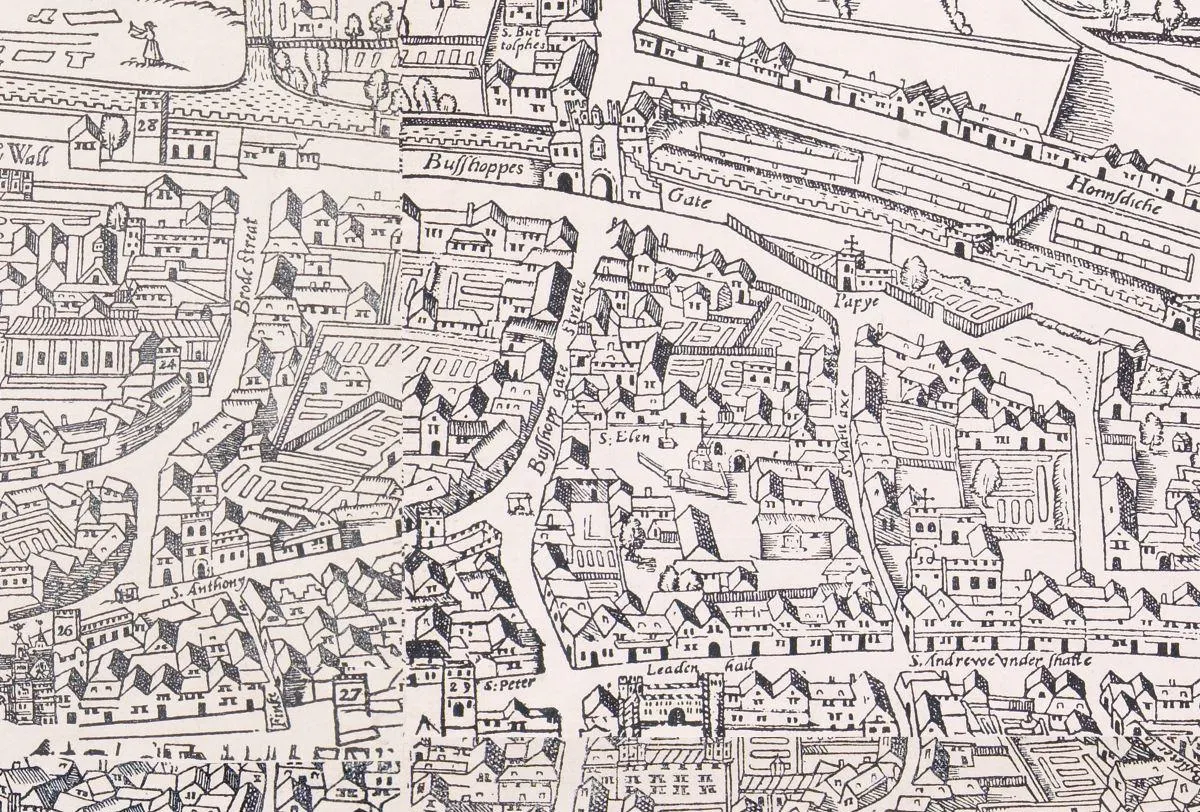
The location of the property, which burned down during the Great Fire of London, was only roughly known, but recent research by Professor Lucy Munro at Kings College London has identified the exact location of Shakespeare's house using the Shakespeare deed and another document held at The London Archives.
Shakespeare's signature
The property deed with Shakespeare’s signature at TLA bears one of only six of the famous playwright’s identified and authenticated signatures in existence. Like the deed itself, it is not straightforward to decipher – Shakespeare wrote in a script called secretary hand which featured many letter forms unfamiliar to us.
Famously, it is said that Shakespeare used a different spelling for his name in each of his signatures. It wasn’t until 1755 that Dr Samuel Johnson published his famous 'Dictionary of the English Language', which standardised the spelling of many English words. Until then, a complicated surname like 'Shakespeare' could easily be spelled in different ways.
But it was also common practice, especially in legal documents, to abbreviate commonly used words as well as personal names. Such abbreviations were usually marked by a horizontal stroke above the abbreviated word or by uppercase letters, and could indicate an abbreviation of one or more letters, and the end or in the middle of a word.
Shakespeare’s signature on the TLA deed reads William Shakspēr. While the initial S, the faded long s, and the p can be easily recognised, the loopy h and k, the a with a long upward stroke, and the 'backwards' e are the less familiar, typical examples of secretary-hand letter forms. The wavy stroke above the e indicates an abbreviation. What letters exactly Shakespeare meant to abbreviate, we will never know, but judging by his other signatures, it would have most probably been the final e.
About the Deed
This is a title deed dating from 1613,when Shakespeare purchased a property in Blackfriars. The vendor is named as Henry Walker, citizen and minstrel of London, while the purchaser was William Shakespeare of Stratford upon Avon, gentleman, supported by three trustees: William Johnson, citizen and vintner of London, and John Jackson and John Hemmyng, both described as gentlemen of London. It is tempting to equate Johnson with the landlord of the Mermaid Tavern, who had that name, and Hemmyng may be the John Heminges who helped sponsor the folio; Jackson’s identity is uncertain.
This is the only London property known to have been owned by Shakespeare, but why he purchased it is uncertain. He may have intended to live there, as it was conveniently situated for both the Blackfriars and the Globe theatres, but there is no evidence that he ever did so. It is more likely that he bought it as an investment, or in order to enhance his status as a gentleman.
The property itself, part of which was erected over a great gate, lay in Blackfriars, in the precinct formerly occupied by the Dominican house dissolved in 1538. It abutted the street leading down to Puddle Wharf, now St Andrew’s Hill, and was ‘right against the Kinges Maiesties Wardrobe’, now commemorated in Wardrobe Place. It had been leased in 1604 to William Ireland, citizen and haberdasher. Shakespeare bequeathed the property to his daughter Susanna Hall, and it came subsequently to her daughter Elizabeth Nash, but it had passed out of family hands by 1667. The deed was purchased by the Corporation of London in 1843 for £145.
Other Shakespeare signatures
All of Shakespeare’s six authenticated signatures date from the last four years of his life and all appear on four legal documents:
- one signature (Wīllm Shakp) on a deposition in the Bellott v Mountjoy law suit, dated 11 May 1612 – at the National Archives, Kew
- one signature (William Shakspēr) on the title deed for the purchase of a house in Blackfriars, London, dated 10 March 1613 – this is the TLA copy (formerly at the Guildhall Library)
- one signature (Wm Shakspē) on the mortgage of the same Blackfriars house, dated 11 March 1613 - at The British Library
- three signatures (William Shakspere, Willm Shakspere, By me William Shakspeare), one on each page, on his Last Will and Testament, dated 25 March 1616 – at the National Archives, Kew
There is also a seventh candidate for a Shakespeare signature, coming from three sheets of additions to the play Sir Thomas More, thought to be the only known literary manuscript in Shakespeare’s hand. It dates from the late sixteenth or early seventeenth century, and is a subject of much scholarly debate. It is kept at the British Library (Harleian MS. 7368).
Further reading
Discover more content relating to William Shakespeare on the London Picture Archive.
Explore more images of William ShakespeareFor more information about the signatures: