
Tracing George Sale’s Qurʾān
Tracing George Sale's Qurʾān by Zeshan Ullah Qureshi
I knew I had to visit The London Archives sooner rather than later. My entire PhD depends on a single manuscript preserved there.
I am a Doctoral Research Fellow in Religious Studies at MF Norwegian School of Theology, Religion and Society, and my PhD is conducted in association with the European Research Council (ERC) funded The European Qur’ān project.
My research topic: “Beyond Orientalism: George Sale, al-Bayḍāwī, and the European Qurʾān Translation Tradition,” explores how the British orientalist scholar George Sale used the Qurʾān commentary (tafsīr) of the medieval Muslim scholar Nāṣir al-Dīn al-Bayḍāwī, to produce history’s first English translation of the Qurʾān directly from Arabic.
Sale had access to a manuscript of al-Bayḍawī’s tafsīr in his own hands, which is now preserved in The London Archives. Seeing and examining this manuscript firsthand was therefore a crucial part of my research.
Background
It is not widely known that European and American Enlightenment thinkers read and were influenced by Islam’s sacred scripture, the Qurʾān. Sale’s translation played a key role in making this possible.
Although largely forgotten today, Sale’s work was likely the most influential English translation of the Qurʾān in history and remained the standard well into the twentieth century. It shaped European perceptions of Islam and influenced major thinkers such as Voltaire, Edward Gibbon, and Thomas Jefferson.
George Sale
Let us turn to the central figure. Sale was a solicitor by profession, a missionary by religious commitment, and an orientalist by intellectual curiosity. The footnotes in his translation demonstrate that he was exceptionally well read, drawing on sources in Latin, Hebrew, and Arabic.
It is not entirely clear how he acquired his knowledge of Arabic in eighteenth-century Europe. Nevertheless, he became sufficiently proficient to work directly with al-Bayḍāwī’s commentary in manuscript form.
He was also involved with the Society for Promoting Christian Knowledge, where he contributed to correcting an Arabic translation of the New Testament intended for use in Syria. He later embarked on his ambitious project of translating the Qurʾān.
Al-Bayḍawī
Turning to Sale’s principal source, al-Bayḍāwī was a Persian medieval Muslim scholar: an Ashʿarī theologian, a Shāfiʿī jurist, and a distinguished Qurʾān exegete from the town of Bayḍā in the Fars region of southern Iran.
He is arguably the best-known Qurʾān commentator in the Western scholarly tradition and, historically, one of the most widely read in the Muslim world.
The Tafsīr
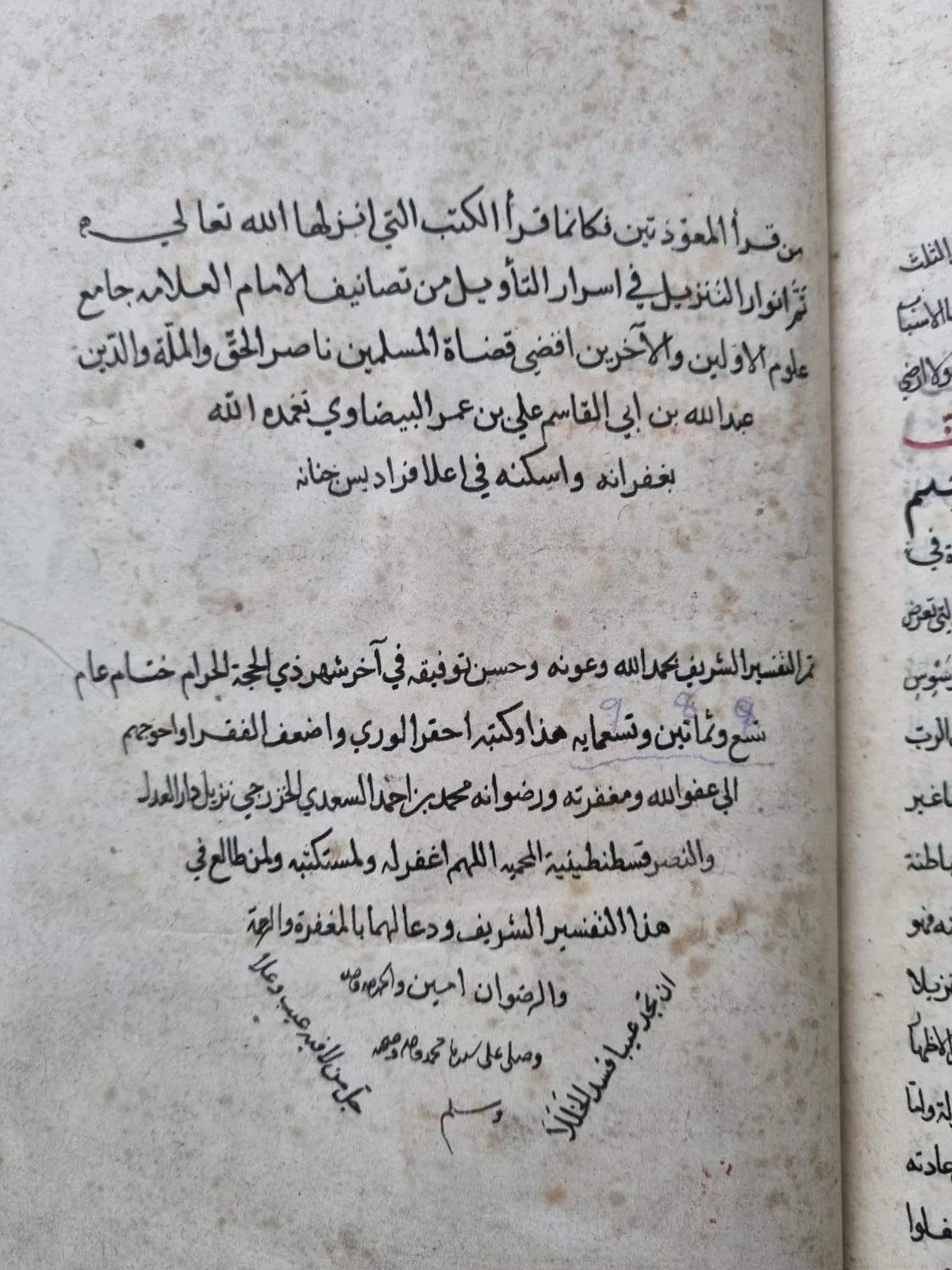
By the late sixteenth century, al-Bayḍāwī’s tafsīr titled Anwār al-tanzīl wa asrār al-ta’wīl (“The Lights of Revelation and the Secrets of Interpretation”), was considered one of the most exemplary works of its kind in the Islamic world. It was widely used in the educational systems of both the Mughal and Ottoman empires.
During the early modern period, as part of the broader movement of Oriental manuscripts into Europe, copies of al-Bayḍāwī’s commentary began to circulate in European collections. Several such manuscripts from this period are still preserved across European libraries and archives.
Manuscript Provenance
Through my research group, I was introduced to recent developments in the field of manuscript studies, particularly the growing scholarly interest in manuscript provenance.
The manuscript of al-Bayḍāwī’s tafsīr used by Sale, now housed in The London Archives, was copied by hand in Istanbul in 1582. Tracing its history has been fascinating. Remarkably, it made its way to the Dutch Church in London in 1633, brought by a trader, and eventually found its way into Sale’s hands nearly a century later.
Understanding this chain of transmission has allowed me to see the manuscript not merely as a text, but as an artefact with its own trajectory, one that connects the Ottoman scribal world with the English Enlightenment.
My Work
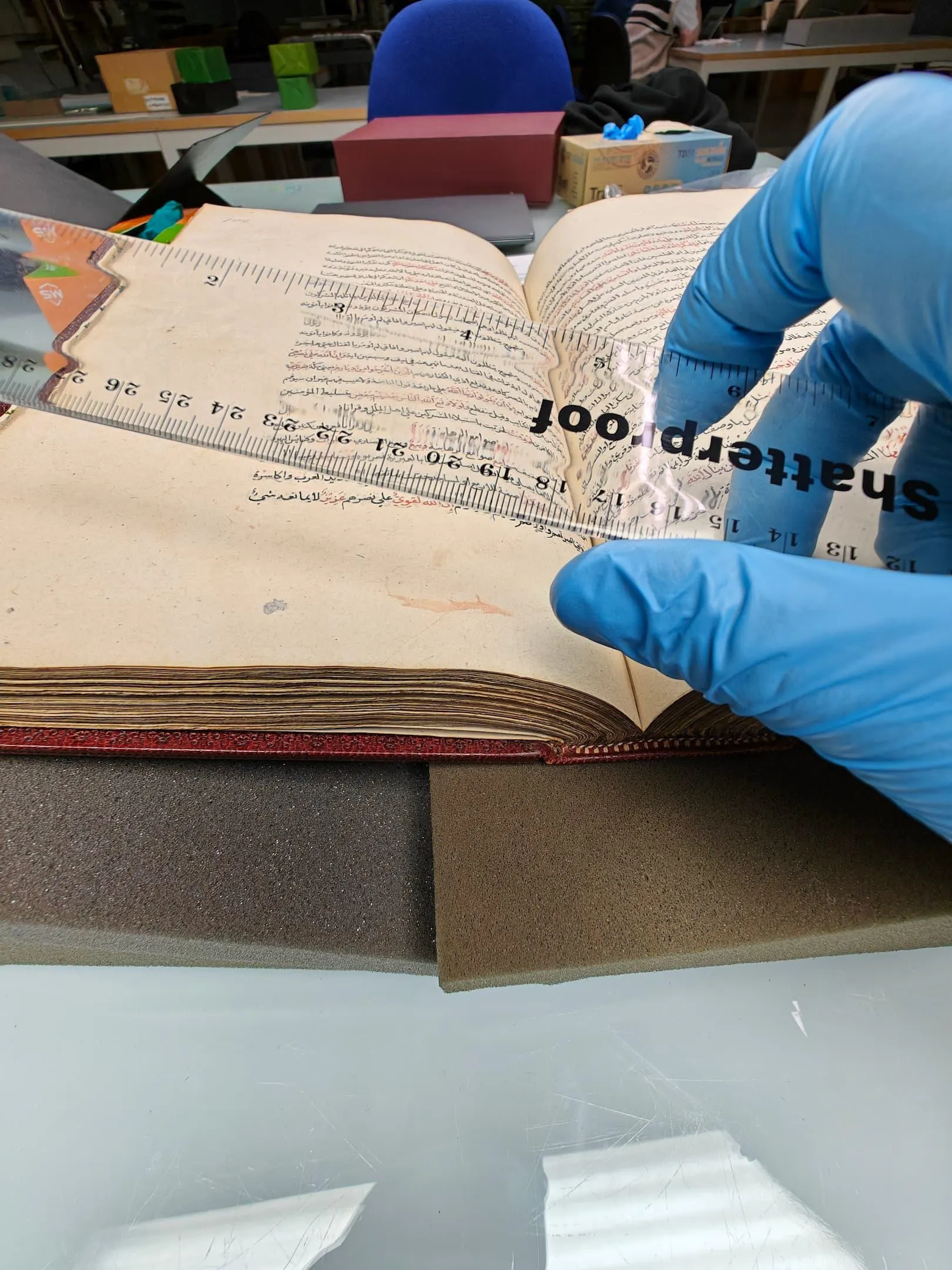
The manuscript consists of approximately 1,170 folios. During my visit, I spent several hours photographing and examining it in detail in the archive’s conservation studio. The archive staff were both helpful and genuinely interested in my research, which made the experience especially rewarding.
Working with the physical manuscript was enlightening in several ways. First, the text is remarkably readable, particularly given its age. This helped me better understand how Sale was able to navigate it with such precision.
The Qurʾānic text is written in red ink, while the commentary appears in black. One particularly striking feature is that the beginnings of the Qurʾānic chapters are marked with green thread sewn into the pages, a beautiful and practical device that I had not encountered before.
Manuscript work differs fundamentally from working with a printed critical edition. With a manuscript, one engages not only with a text, but with a physical object that bears the marks of time, travel, and human use.
Future Steps
Now that I have gathered the material, I am studying Sale’s engagement with this tafsīr in detail. This involves comparing key references in his translation with the corresponding passages in the manuscript.
One might ask why I undertook such a journey when critical editions of the tafsīr already exist. Why not simply rely on published versions?
The answer is that examining the exact manuscript used by Sale is essential for original research. Variations between manuscripts can be significant. A passage that appears unclear for my purpose in a critical edition may become intelligible when examined in the specific manuscript Sale himself consulted.
Concluding Remarks
The al-Bayḍāwī manuscript became Sale’s most frequently cited source in his Qurʾān translation, which he references 763 times in his footnotes, on nearly every page. Comparing all of these references would likely be too extensive even for a PhD project.
Instead, I will select and analyse those passages that offer the greatest insight into this remarkable intellectual engagement. My aim is to contribute new knowledge about this manuscript and its role in shaping the first English translation of the Qurʾān directly from Arabic.
More specifically, I seek to examine how Sale engaged with this manuscript, not only as a physical source, but as part of a deeper intellectual encounter, and to explore the kinds of questions he attempted to address through it.
In the end, this manuscript reveals not only how Sale translated the Qurʾān, but how Islamic scholarship itself became part of the intellectual fabric of the European Enlightenment.
Important note
The Qurʾān commentary is available only under special conditions with the advance notice of TLA's Director (reference: CLC/180/MS20185/011).