

Reforming the Recalcitrant Apprentice
Reforming the Recalcitrant Apprentice
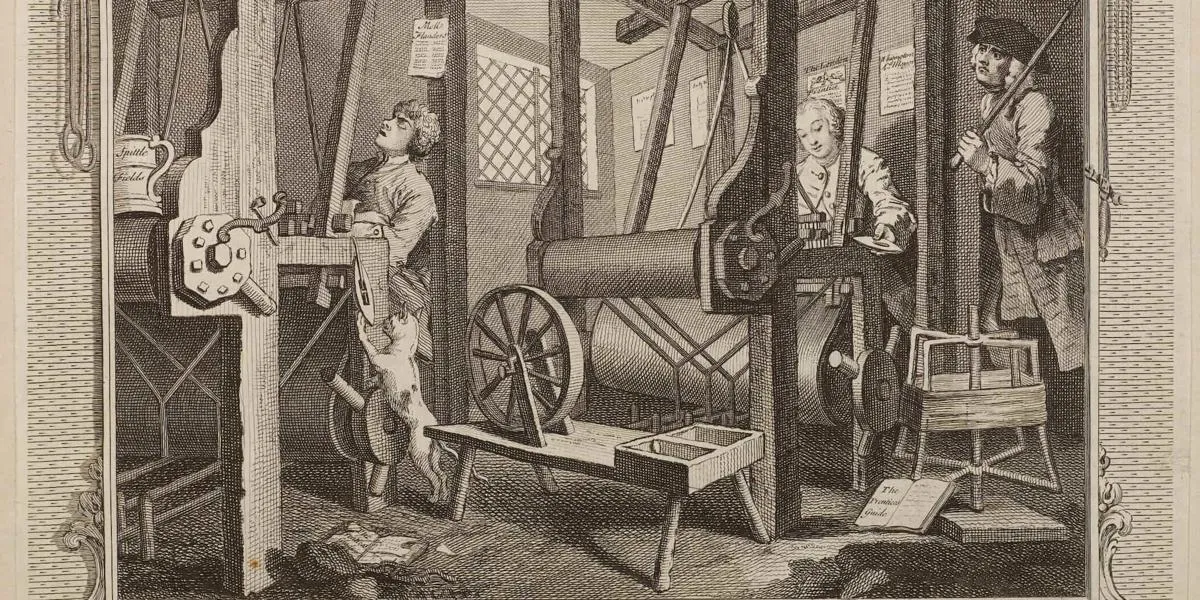
From the medieval period, many young people were apprenticed to Freemen of the City of London livery companies to learn a trade. Whilst both sexes could be apprenticed, there were fewer trades open to young women and they appear less in the surviving records.
Usually starting between the ages of 14 and 21, they would be apprenticed to their master (or sometimes, mistress) for seven years by signing an indenture. The indenture was a contract binding the master and apprentice; the master agreeing to house, feed, and clothe the apprentice alongside teaching them the trade, the apprentice agreeing to be obedient, not to visit taverns or gamble, nor ‘commit fornication’, or absent themselves without permission.
With such strict rules in place to control behaviour, disputes sometimes arose between master and apprentice that needed to be settled by a third party, and could result in harsh punishment for recalcitrant apprentices.
The Chamberlain's Role
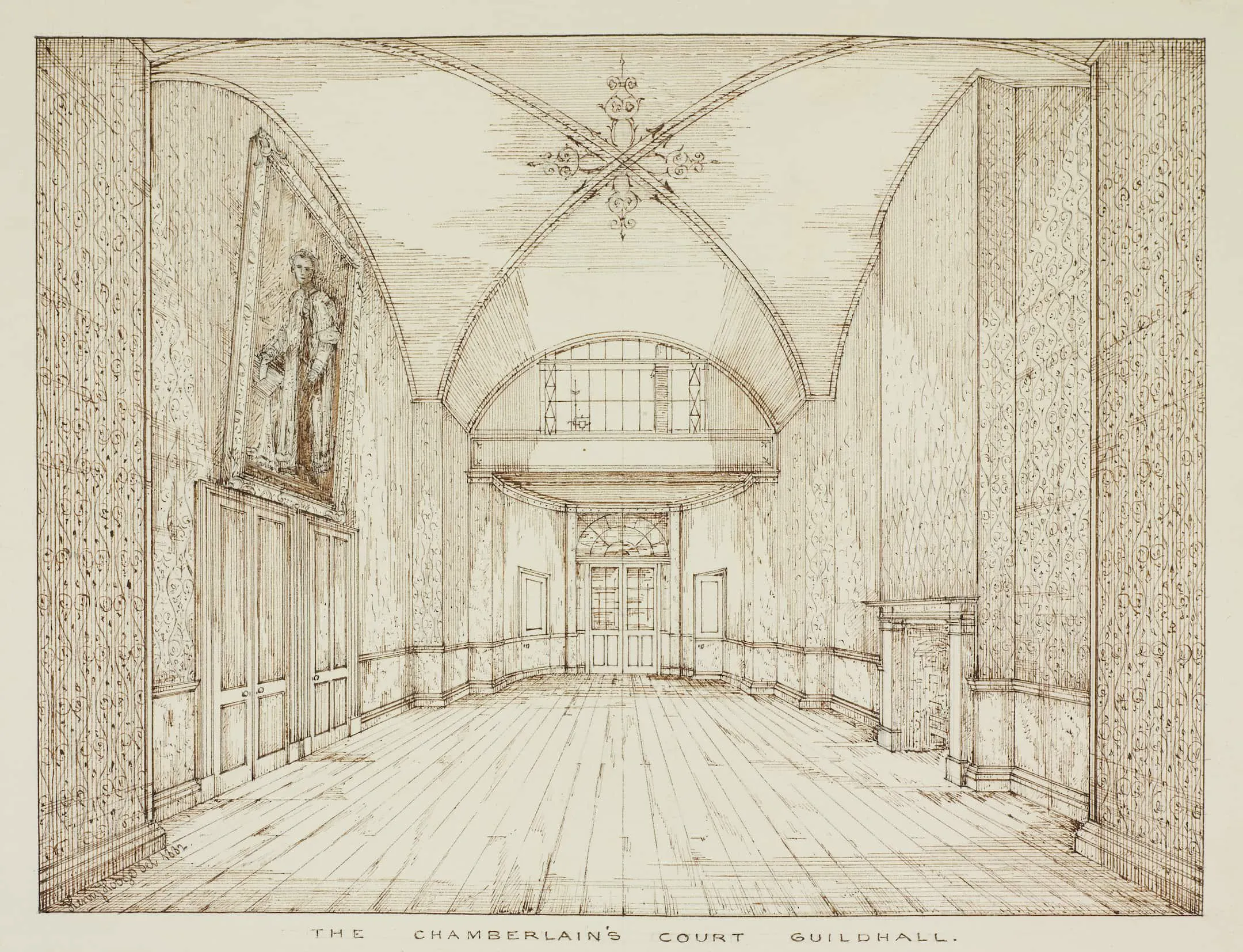
The Chamberlain is the chief financial officer of the City of London and was, historically, involved in the administration of apprenticeships. Masters were responsible for having indentures enrolled by the Chamberlain within a year of being bound for a small fee (but many failed to do this). Other than enrolment, the Chamberlain was responsible for settling disputes between master and apprentice through the Chamberlain’s Court at Guildhall.
The Chamberlain kept records of these disputes through a series of ‘complaint books’, recording the date of the hearing, names of those involved, length of apprenticeship completed by the apprentices, details of the complaint, and the ruling of the Chamberlain. Unfortunately, a fire in the Chamberlain’s office in 1786 destroyed all complaint books along with many other records relating to apprenticeship. For this reason, The London Archives only holds complaint books from February 1786 onwards.
The Court was a fairly cheap way for masters and apprentices to formally voice complaints about each other, costing only 3 shillings to be heard. Whilst apprentices could, and did, use this process to complain, the most the Chamberlain could do was reprimand masters and tell them to change their behaviour. For this reason, many apprentices chose to instead pursue their complaint through the Lord Mayor’s Court as they had a good chance of being able to exit their indenture this way.
Masters had a much better chance of getting results from the Chamberlain. The master-apprentice power dynamic resulted in the Chamberlain leaning towards punishing apprentices and dismissing cases against masters. Unlike with masters, the Chamberlain possessed real power to punish apprentices.
Complaints Books
Much of our knowledge on the Chamberlain’s complaints process relies on the survival of the complaints books (see reference: COL/CHD/AP/04/02). Aside from the details of complaints and complainants, in the later volumes we are fortunate to have loose papers inserted into them. These include summonses, further details on specific complaints, letters from masters and apprentices, and letters from family members of accused apprentices. Covering the years 1786 to 1917, you can explore the full range of documents yourself at The London Archives. Later volumes contain an index of complaints by name.
Complaints Procedure
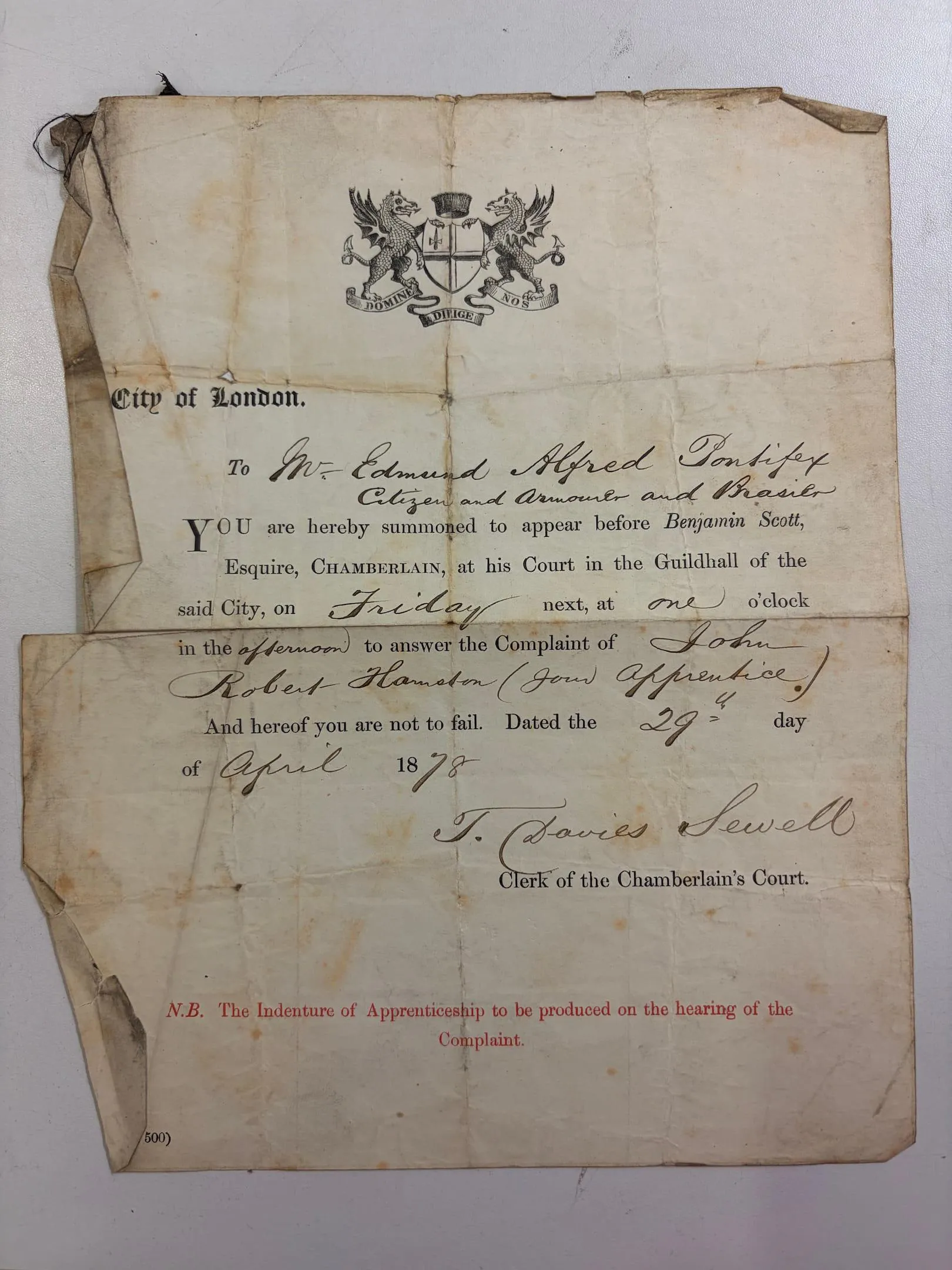
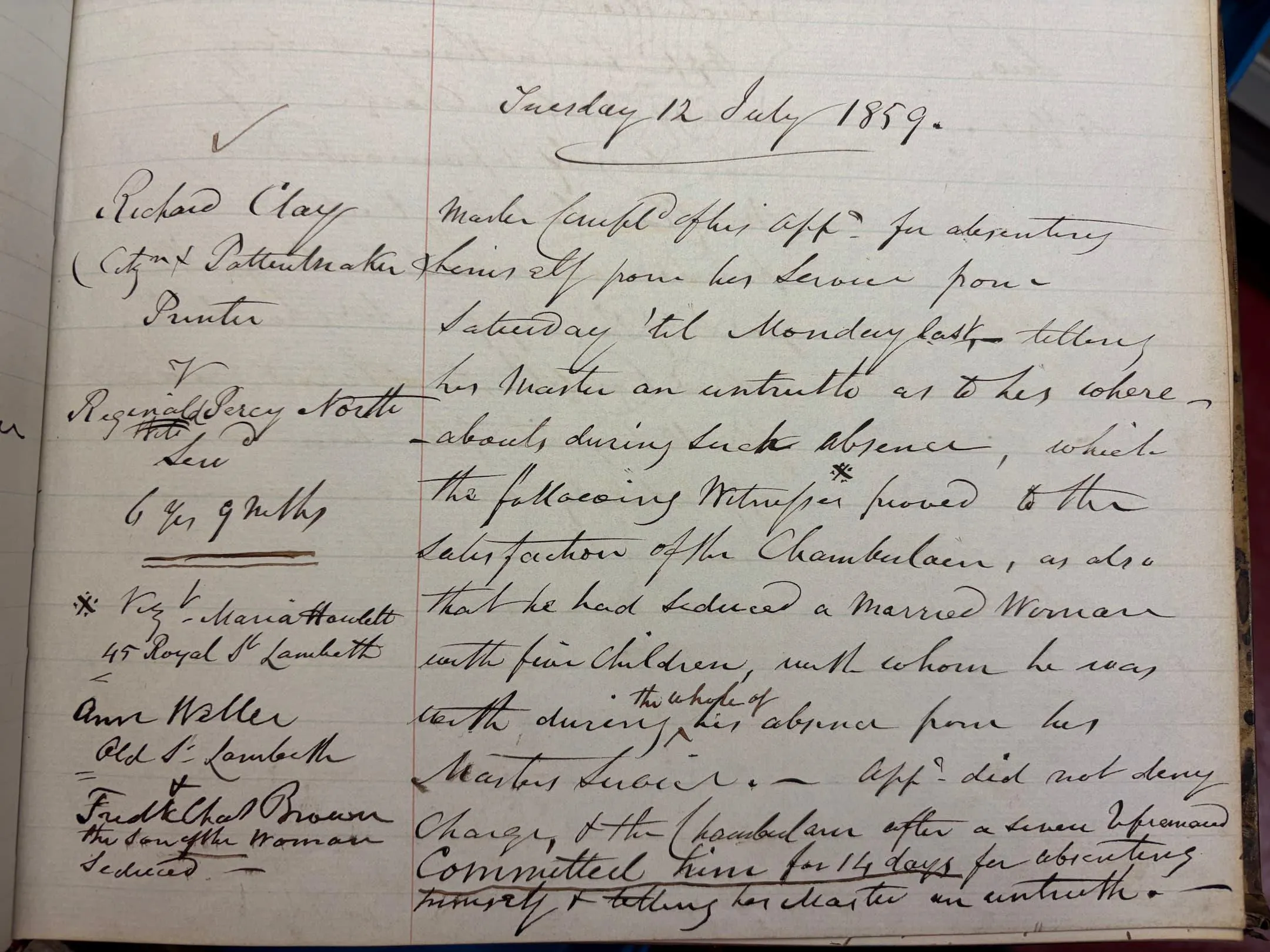
On payment of the three-shilling fee, a summons would be sent to the offending party (most commonly the apprentice) detailing the date and time of the hearing at Guildhall.
The case of Reginald Percy North
The master and apprentice would then present their case, which was recorded in the complaints book. Some apprentices appear multiple times. Witnesses were allowed to be called but they rarely appear in the official record. A notable exception is a case from July 1859 where:
witnesses proved to the satisfaction of the Chamberlain… that [Reginald Percy North, apprentice] had seduced a married woman with five children
Three witnesses were called including Frederick Charles Brown, “the son of the seduced woman”.
The case of Charles Fruin
Some masters used the Chamberlain’s court prolifically, such as George Andrew Spottiswoode, Citizen and Stationer. Spottiswoode appears many times and took on numerous apprentices, one being Charles Fruin. Charles was bound to Spottiswoode for seven years on 9 April 1861 to learn the printing trade. His father, Thomas Fruin, was a printer at 24 Garnault Place, Clerkenwell, at the time the indenture was made.
Only five months into the apprenticeship, Charles appeared before the Chamberlain accused of “gross neglect, in doing his work very slovenly, talking v[ery] impudently… in the office, displaying great inattention to the business he was transacting which he had been put to as punishment (after the time of work on Saturday) in consequence of bad conduct”. Charles had no answer for this but promised to behave better in the future. As this was his first offence, the Chamberlain adjourned the complaint for one month, and no more appears to have come of this suggesting Charles’ conduct improved in this period.
This, however, wasn’t to last. On Tuesday 28 November 1865, Charles made his second appearance before the Chamberlain accused of “absenting himself from his master’s service on Friday last at ½ past 6 in the evening and remaining absent on Saturday and Monday without leave.” Once again Charles “could not justify such misconduct”. Unfortunately for Charles, Spottiswoode was “pressing for punishment” so the Chamberlain committed Charles to Bridewell Prison for fourteen days. Bridewell was the harshest punishment the Chamberlain had the power to impose.
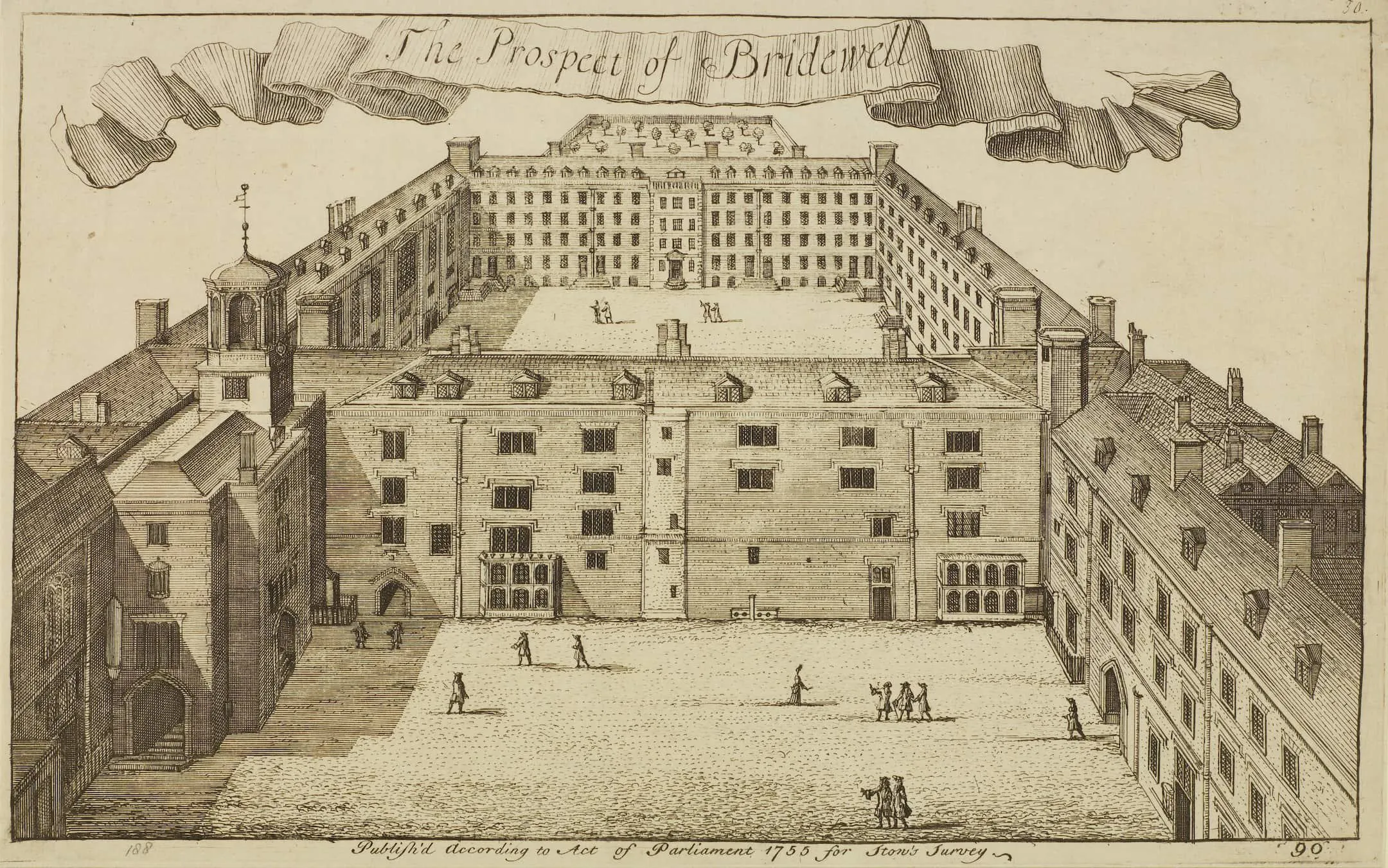
Bridewell Prison
Established in the sixteenth century, Bridewell was the first ‘house of correction’ in the country. Located on New Bridge Street on the site of a former palace, Bridewell functioned to imprison and punish petty criminals, as a charitable organisation for the poor of the City of London, and a place the Chamberlain could send misbehaving apprentices for anywhere from a few days to a few months.
These apprentices were housed away from the petty criminals as getting sent to Bridewell by the Chamberlain for recalcitrant behaviour was not a criminal offence. Apprentices were kept in solitary confinement, requiring permission to receive visitors. They received daily visits from the vicar of Saint Bride’s Church who was charged with reforming apprentices’ moral character. Whilst conditions at Bridewell do appear to have been better than other prisons, prisoners and apprentices alike were engaged in hard labour during their stay. The most common task, beating hemp.
Bridewell closed in 1855 but retained six cells for the confinement of City apprentices until the early twentieth century. By this time City apprenticeships had become less popular so fewer apprentices were being committed to Bridewell.
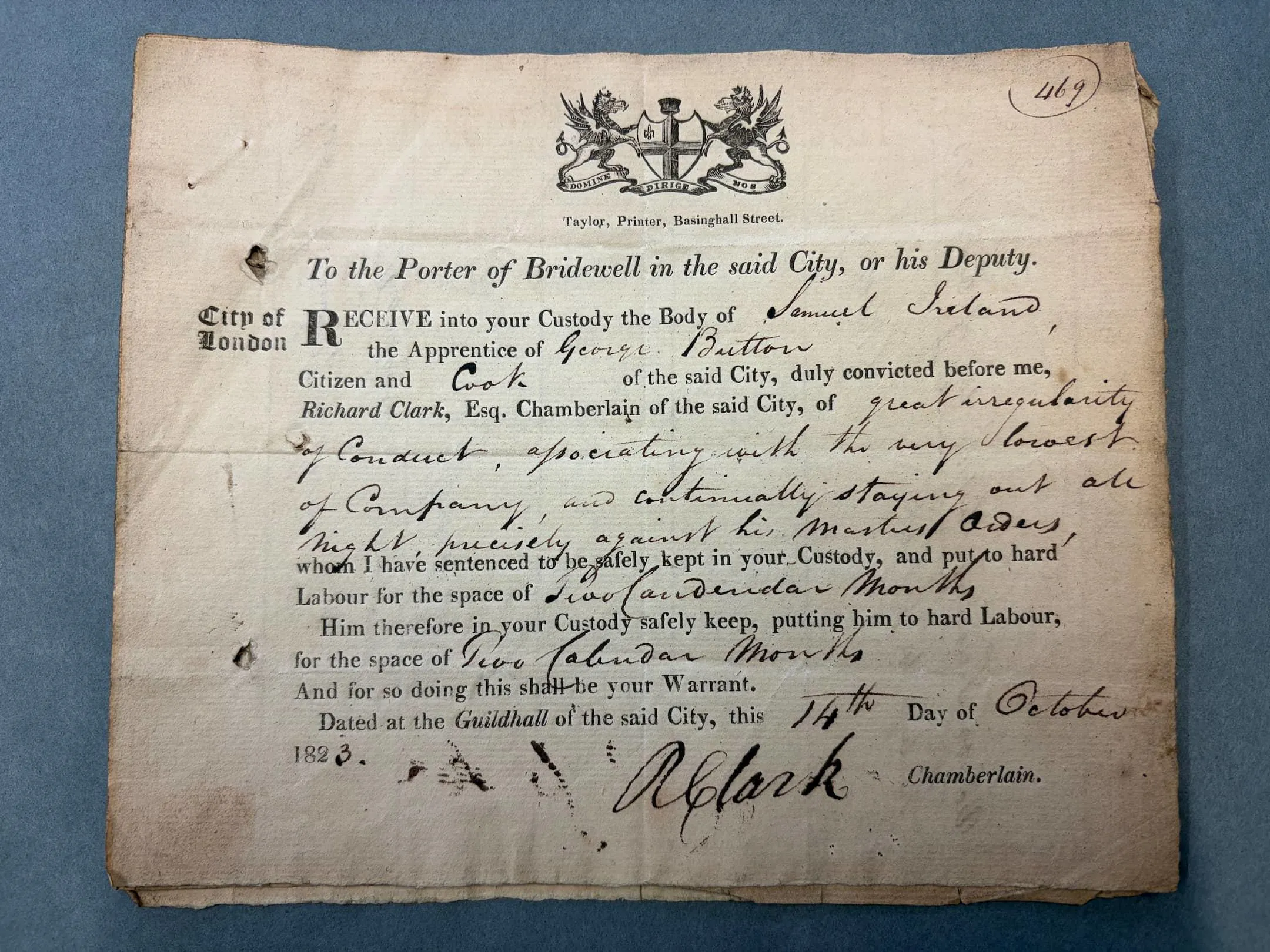
Leaving Bridewell
Within the complaints books are numerous letters from apprentices begging their masters for early release from Bridewell. Locked away in solitary confinement and performing manual labour would have been a sobering experience for the young people unlucky enough to have received this punishment.
Charles Fruin wrote one such letter to Spottiswoode dated 1 December 1865, pleading for release.
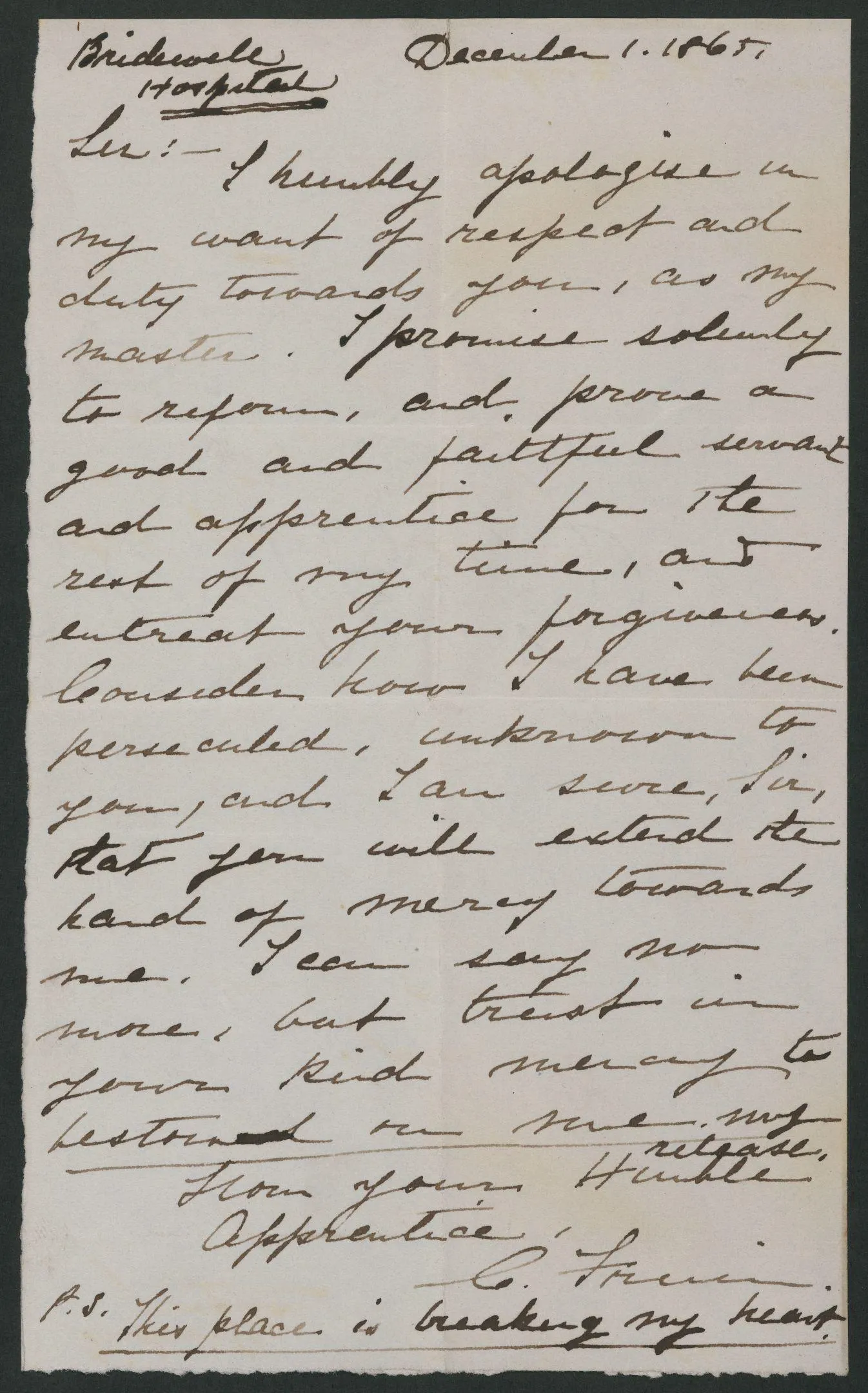
I humbly apologise in my want of respect and duty towards you, as my master. I promise solemnly to reform, and prove a good and faithful servant and apprentice for the rest of my time, and entreat your forgiveness. Consider how I have been persecuted, unknown to you, and I am sure, Sir, that you will extend the hand of mercy towards me. I can say no more, but trust in your kind mercy to bestow to me my release. From your humble apprentice, C. Fruin.
The postscript is particularly evocative, adding “P.S. This place is breaking my heart”.
Clearly there was something going on in Charles’ life that he did not feel comfortable or able to tell his master or the Chamberlain, but we will never know what he means by having been ‘persecuted’. The more cynical among us may suggest Charles is dissembling to get out of his punishment early, but the facts of the situation have likely been lost to history. Spottiswoode thought the letter sincere as he forwarded it along with his own letter to the Chamberlain. Spottiswoode requested the Chamberlain release Charles but not until “Monday next”, letting him suffer just a few days longer to ensure the message of who held the power in their relationship was understood.
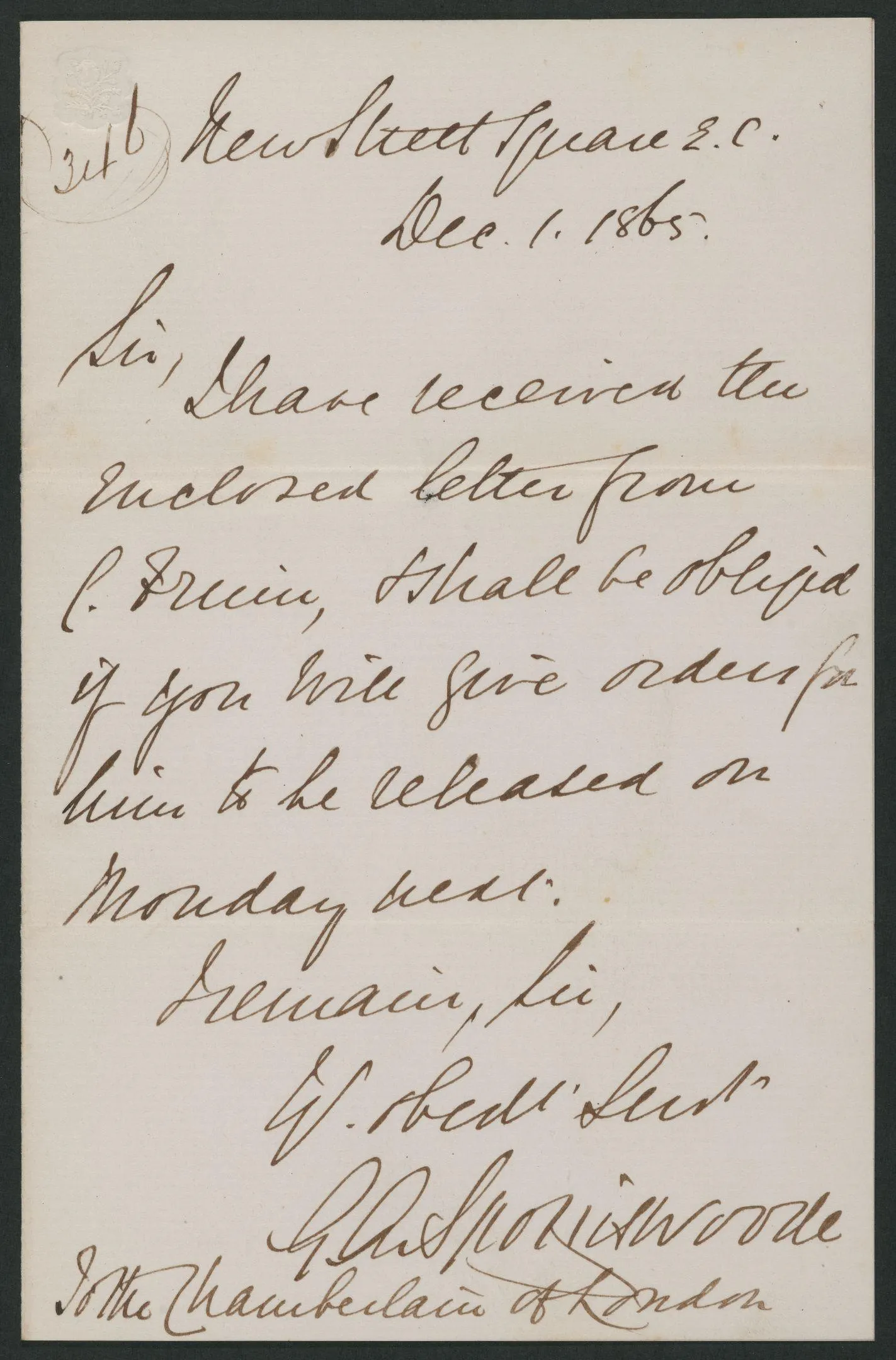
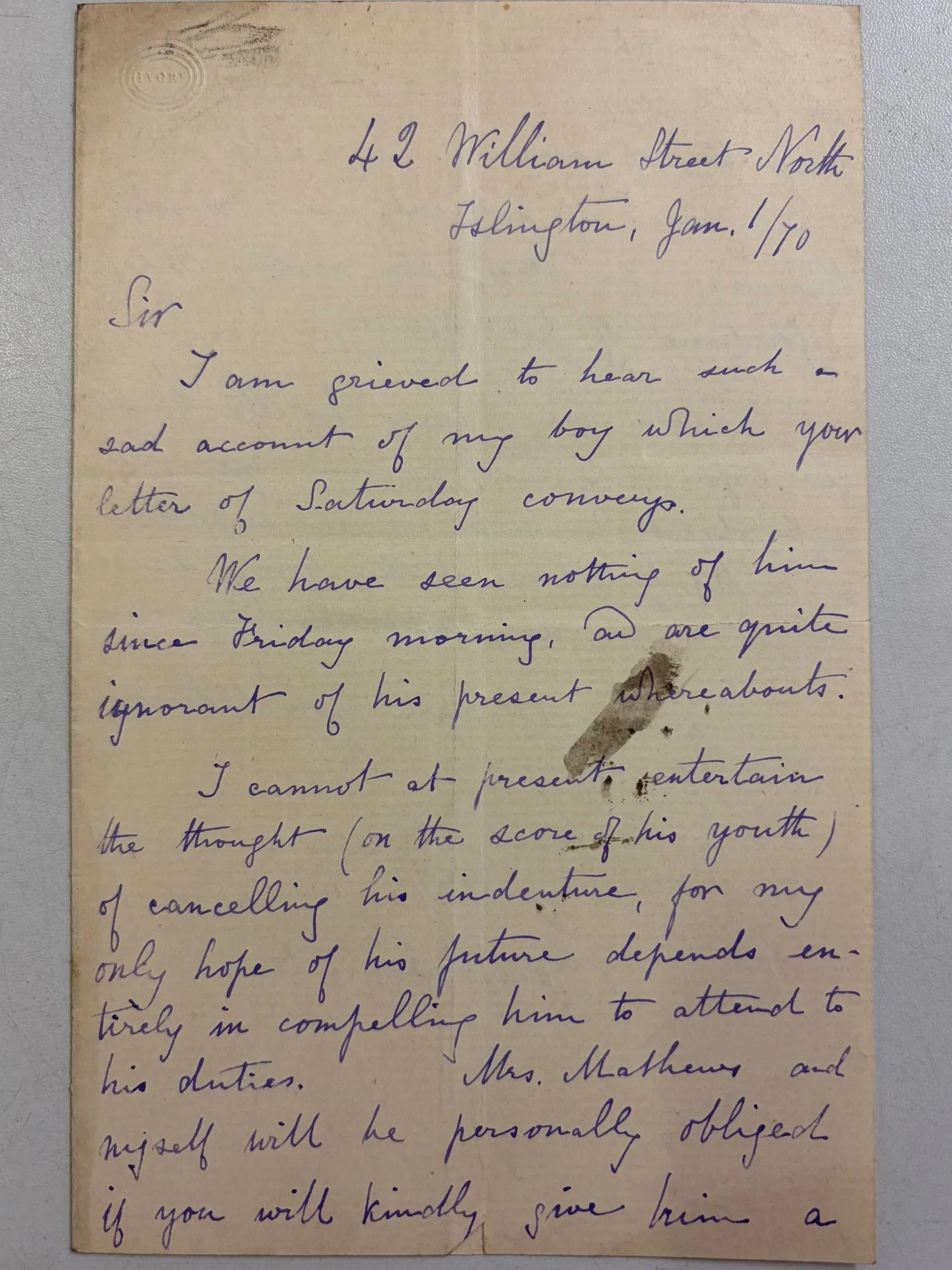
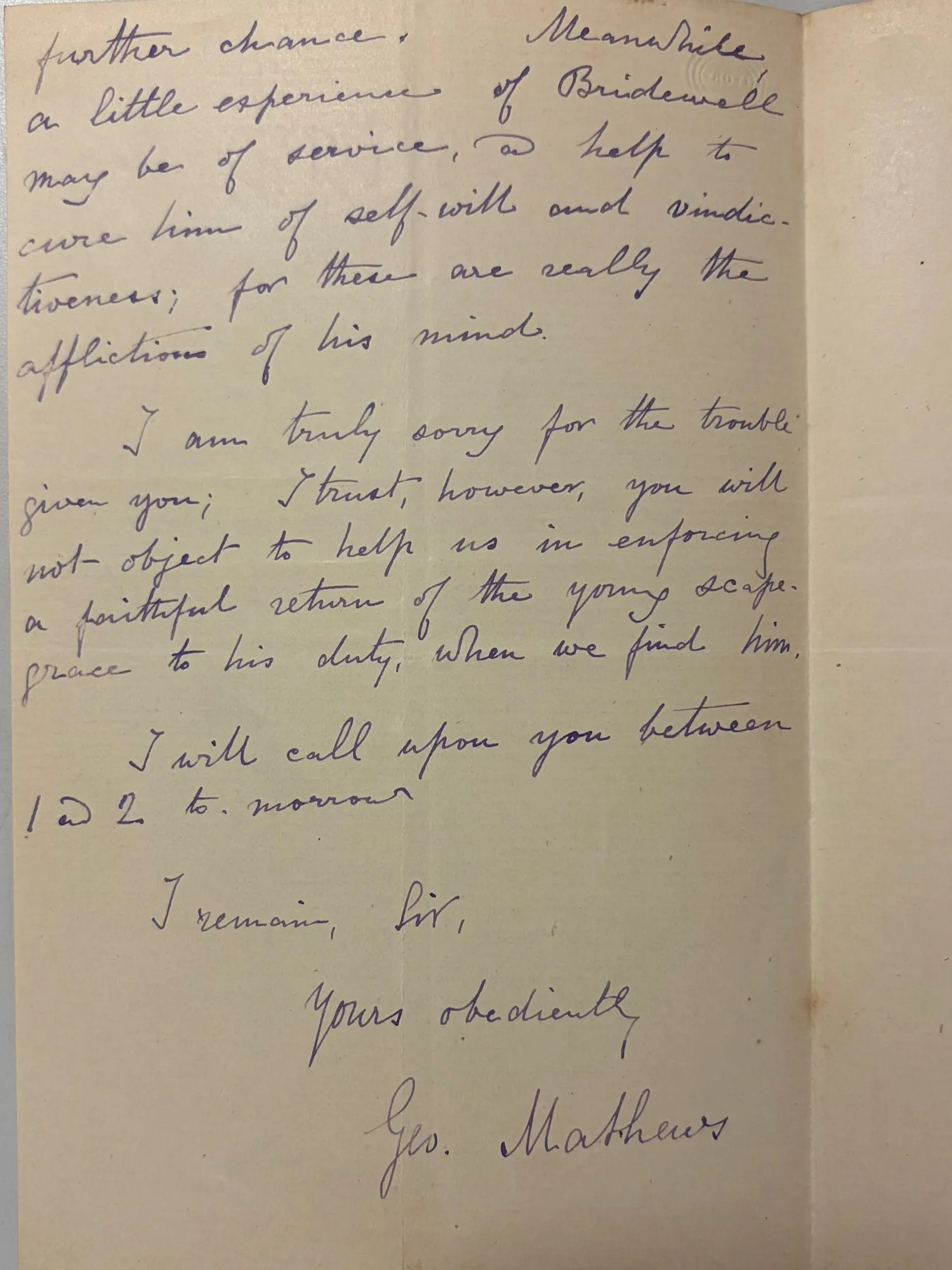
Where differences between master and apprentice could not be reconciled, they sometimes agreed to end the apprenticeship. In Charles Fruin’s case, there is no known evidence he completed his apprenticeship. Although the popularity of City apprenticeships had diminished by the nineteenth century, they were still a valid way for young people to learn a trade. The threat of apprenticeships being cancelled due to bad behaviour was a real worry for parents, as this could be their child’s only way into a trade. A letter from George Matthews to his son’s master shows this worry as George’s “only hope for his [son’s] future depends entirely on compelling him to attend to his duties”. George proceeds to suggest “a little experience of Bridewell may be of service and help to cure him of self-will and vindictiveness”, promising the “faithful return of the young scapegrace to his duty”.
With eighteen volumes of complaint books in the archives (references: COL/CHD/AP/04/02/001-018), there are many more stories to discover.
Explore 'Londoners on Trial'
Find out more about criminal London from 1244 to 1924 in our exhibition 'Londoners on Trial'.
Londoners on Trial exhibitionFurther Reading
Chaffin, W. L., & Wallis, P. (2023). Unmaking Apprenticeship in Early Modern London: Goldsmiths’ Apprentices and the Lord Mayor’s Court, 1597–1720. The London Journal, 48(2), 99–121.
Walls, P. (2025). The Market for Skill: Apprenticeship and Economic Growth in Early Modern England. Princeton University Press.
For more information on City apprenticeships and Bridewell see London Lives - https://www.londonlives.org