

The Clerkenwell Explosion of 1867
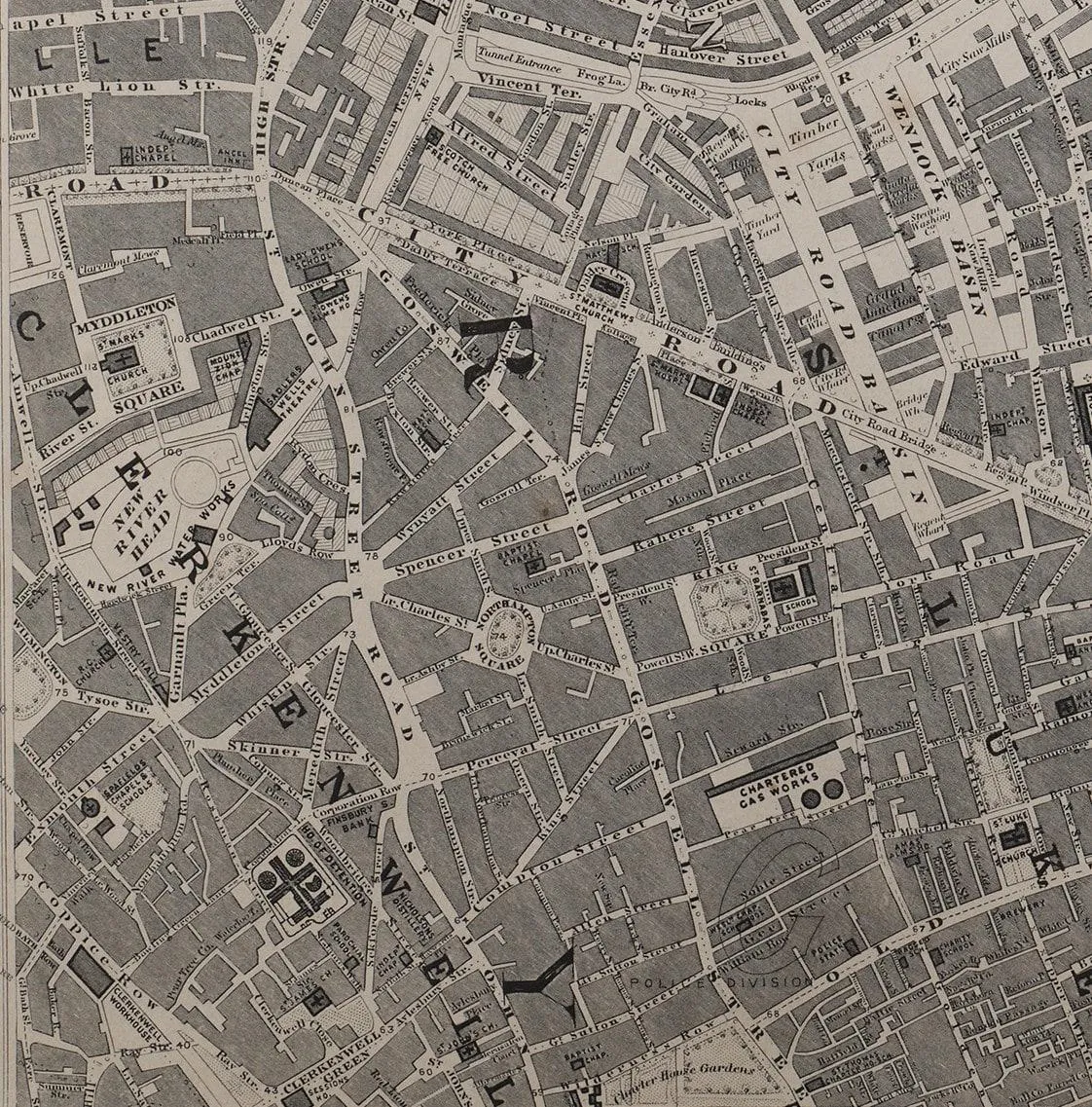
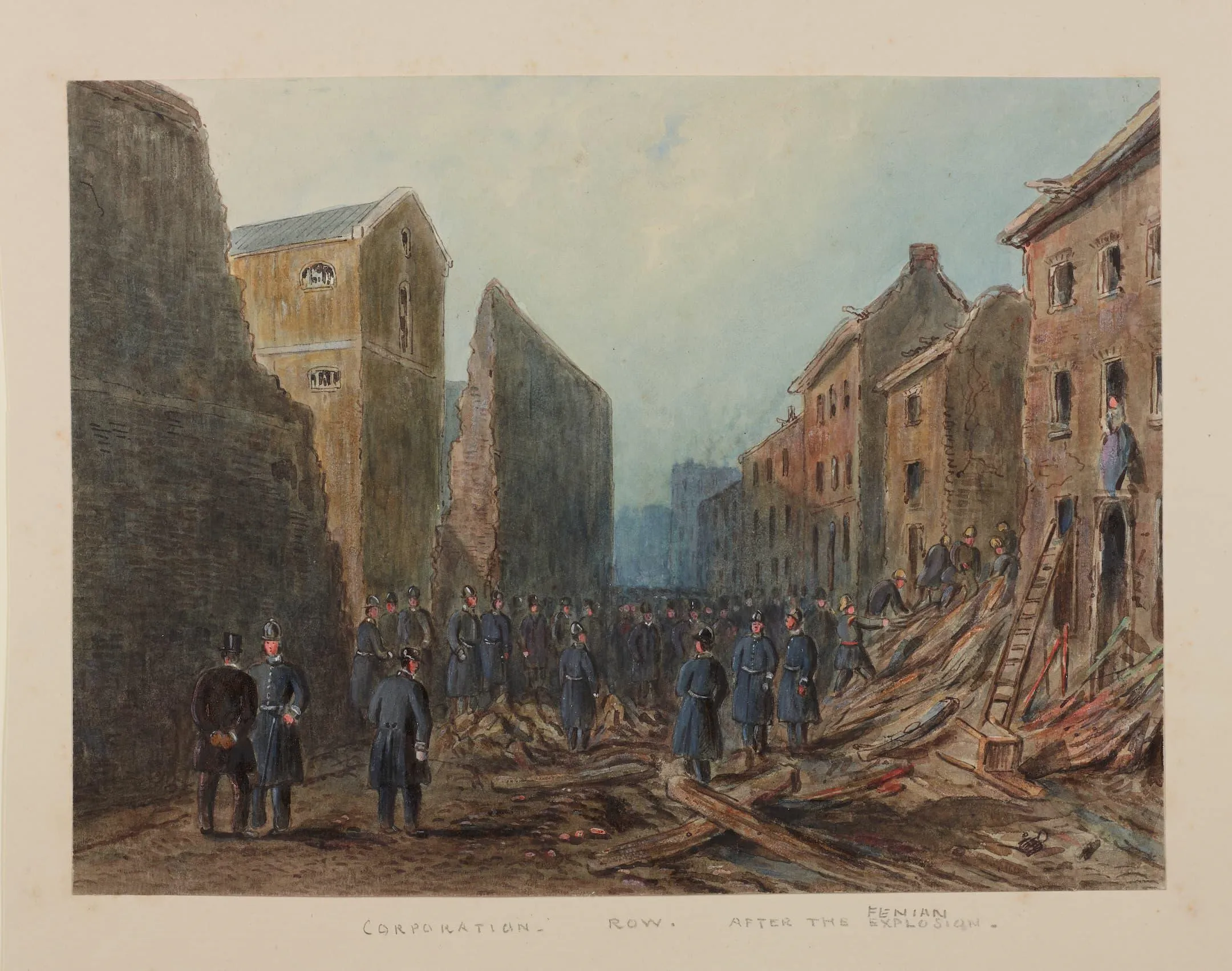
On Friday 13 December 1867, Clerkenwell became the centre of a Fenian plot. Using gunpowder, the plan was to blow a hole in the wall of the prison exercise yard to allow two members of the Irish Republican Brotherhood, being held on remand at the House of Detention, to escape. What transpired was an explosion leading to the deaths of 12 people, injuries to over 100, and the destruction of tenement houses on Corporation Lane (now Corporation Row) opposite the prison wall.
Irish Republican Brotherhood
The Irish Republican Brotherhood (IRB) were founded in Dublin on St Patrick’s Day 1858, inspired by the United Irishmen before them, they aimed to secure an independent Irish republic through inciting risings. A secret society, the IRB soon spread outside of Ireland due to the Irish diaspora, many of whom emigrated to escape the horrors of an Gorta Mór (the Great Hunger) of the previous decade.
Members became known as ‘Fenians’, a name originating from the Fianna, bands of young hunter-warriors in Irish legend. Notable later members include Michael Collins, Director of Intelligence for the Irish Republican Army during the War of Independence and later commander-in-chief of the National Army until his death in 1922 in an ambush at Béal na Bláth, County Cork, during the Civil War. Collins had moved to London in 1906 to work in the Post Office Savings Bank, West Kensington. He was sworn in to the IRB in 1909 at Barnsbury Hall, Islington, later becoming president of the IRB’s supreme council.
The Situation in 1867
The Irish Republican Brotherhood organised an armed rebellion in 1867 to abolish British rule of Ireland, known as the Fenian Rising. The Rising was largely funded by Fenians in America and was partly sparked by the suppression of radical newspaper, 'The Irish People' and the arrest of four Fenian leaders for publishing treasonous material in 1865. In March 1867, the IRB centred the Rising on Tallaght, aiming to lure British forces out of Dublin where another uprising was planned. Due to poor planning and a tip off to the British, the Rising failed in its objective.
Disturbances were not limited to Ireland, and IRB action continued throughout 1867. The authorities at Dublin Castle, the headquarters of British administration in Ireland until 1922, became aware of the possibility of upcoming Fenian attacks. In Manchester in September 1867, two men were arrested under the vagrancy laws for loitering, these turned out to be Fenian leaders and so were charged with further crimes. An attempt to free the men during their transport to court succeeded but resulted in the killing of an unarmed police officer and the arrest and execution of three men. Ricard O’Sullivan Burke, an IRB member originally from West Cork but based in Birmingham where he organised the import of arms for the Fenian cause, organised the escape before moving to London.
IRB Activity in London
On 20 November 1867, a few days after the execution of the three IRB men known as the Manchester Martyrs, Ricard O’Sullivan Burke was arrested alongside Joseph Theobold Casey. Burke had been spotted in St Pancras by an inspector from Scotland Yard who had a warrant for his arrest for treason-felony. Confronting Burke at Woburn Square, Burke gave his name as George Berry, reportedly claiming to be a medical student just arrived from Germany. Burke resisted arrest aided by Casey who assaulted the inspector. Casey followed the group to the station where he was spotted and detained. Both Burke and Casey were brought before the magistrate at Bow Street Police Court on Saturday 23 November for treason and resisting and assaulting the police for Burke, and resisting and assaulting the police for Casey – they were remanded in custody at the House of Detention, Clerkenwell.
The Clerkenwell Outrage
With Burke and Casey at Clerkenwell Prison awaiting their trial at the Old Bailey, a plan was made to break them out. On 12 December, a group of Fenians attempted to blow a hole in the prison wall, timed to coincide with when the prisoners took exercise. A barrel of gunpowder was placed next to the wall, but failing to light the fuse, the attempt was called off.
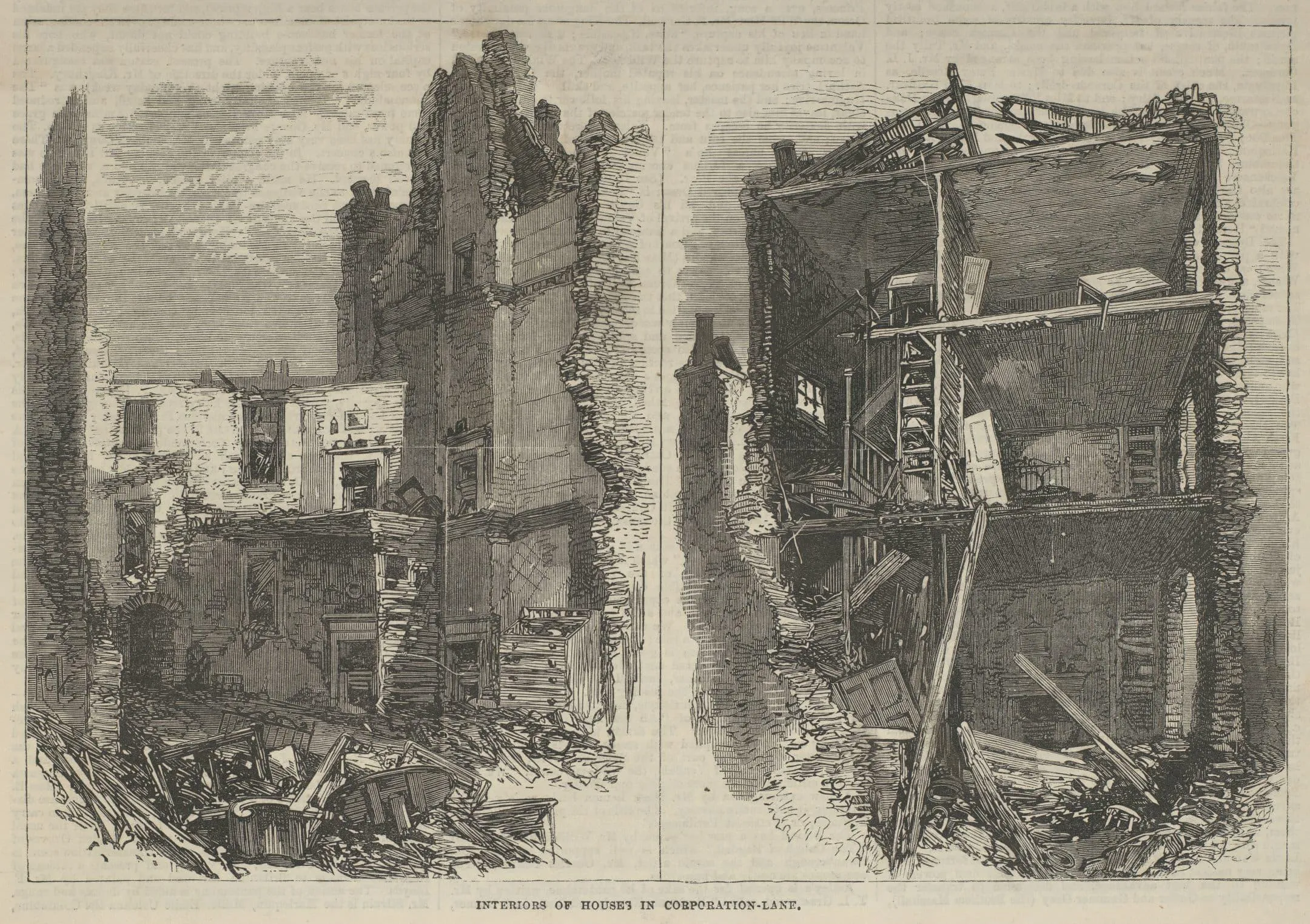
The next day, the group returned, placing the gunpowder in a cart against the prison wall. At approximately 3:45pm the barrel successfully detonated, bringing down 60 feet of prison wall. Tragically, the destruction did not stop there. The Fenians had far overestimated the quantity of powder needed to bring down the wall. With possibly up to 250kg of gunpowder used, the resulting explosion threw bricks into the prison yard, broke windows throughout Clerkenwell, and destroyed the tenement houses on Corporation Lane – killing and injuring those in their homes. The plot to free the Fenians did not pay off.
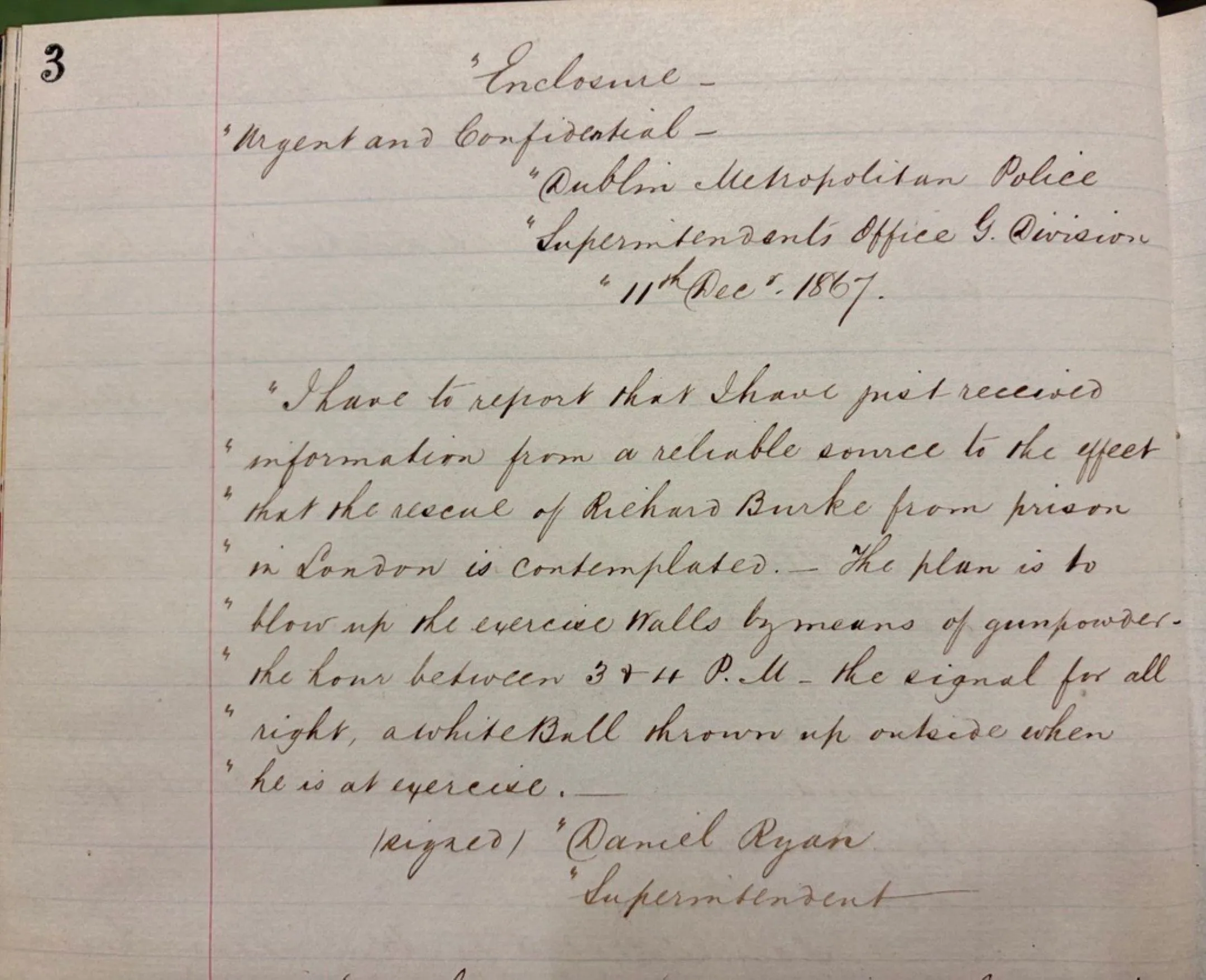
Dublin Metropolitan Police had informed the Home Office of intelligence suggesting that an attempt to break “Richard Burke” out of prison by blowing up the exercise yard wall was to be made. This information was then passed to the Chairman of Middlesex Quarter Sessions, and from him to Clerkenwell’s prison governor. In response, the prison governor changed the time and place the prisoners took exercise each day, borrowed prison officers from Cold Bath Fields to assist in case there was need, and worked with the London Metropolitan Police to ensure an increased police presence in the area. Detailed accounts of the explosion made by various members of staff at the prison, damage to the prison, and other fascinating details can be found in document reference: MA/G/CLE/0014, Minutes of the Committee of Visiting Justices of the Middlesex House of Detention.
A plaque in memory of the victims was erected in St James’ church, Clerkenwell Close. It lists the three persons killed instantly as William Clutton, aged 47, Sarah Hodgkinson, aged 30, and Minnie Julia Abbott, aged only seven. Three more died soon after – Humphrey and Martha Evans, aged 67 and 65, and Martha Elizabeth Thompson, aged 11. The plaque also mentions nine people died later. The usual figures stated, however, are 12 dead and over 100 injured. Some injuries were life changing - Arthur Abbott, brother of Minnie Abbott who was killed instantly, was left completely blind.
The Culprits
A total of eight people were charged for murder, with six going on trial at the Old Bailey in April 1868. William Desmond, Timothy Desmond, Nicholas English, John O'Keefe, Michael Barrett and Anne Justice were tried. Patrick Mullany turned Queen’s Evidence, and Jeremiah Allen was discharged with some reports he was a police informant. As the case against Anne Justice was slight, and the evidence against O’Keefe insufficient, their charges were withdrawn. The trial and the evidence of Mullany quickly led to the focus being put on Michael Barrett.
The gunpowder used came, at least partially, from Messrs Curtis and Harvey, gunpowder manufacturers at 74 Lombard Street, where four half-barrels of gunpowder weighing 501lbs each were delivered to 8 Pulteney Court. A ‘Mr Smith’ received the order. Witnesses testified that Michael Barrett had been seen at the premises on Lombard Street on multiple occasions, suggesting that Mr Smith was Barrett. The testimony was at odds with Barrett’s claim that he was in Scotland at the time of the explosion, a claim corroborated by witnesses. Mullany stated that it was Barrett himself that lit the fuse.
My dear friend, you will be very much grieved to hear the serious reverse that has befallen me lately, the cause of which I am as ignorant of as yourself; nevertheless, I have got into the meshes of the law, and when once fairly entangled, it is no easy matter to get extricated. It is needless to enter into details, as now you will have learned all the particulars through the public press. I wish you to go to Mr. James Mullen, who will take, you to a shoemaker named McNulty, in Bridgegate Street; mention my name, and see if he remembers doing a little work for me at the time this crime, of which I am supposed to be the author, was committed.
Despite the doubt cast by Barrett’s alibi, his absolute denial of guilt, and some being sympathetic to his situation and the paucity of evidence, Barrett was found guilty. William and Timothy Desmond and Nicholas English were found not guilty. Michael Barrett was sentenced to death; he was 26 years old.
On 26 May 1868, outside of Newgate Prison, Michael Barrett was publicly hanged before a jeering crowd, the last public execution in the country.
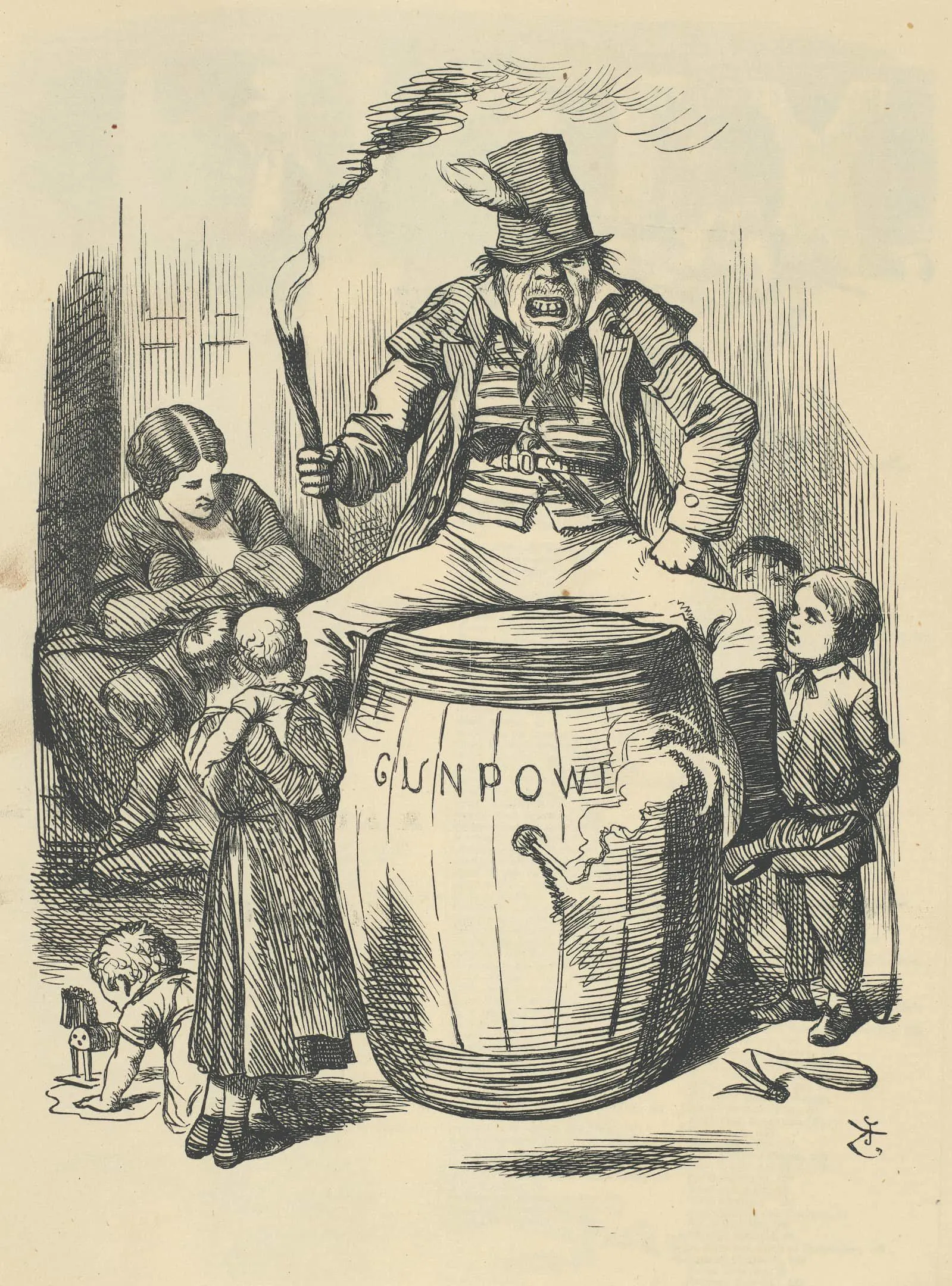
The events at Clerkenwell served to intensify hostility and suspicion of the Irish community at a time where anti-Irish sentiment was already rife. The killing of civilians understandably angered the British population, but the majority of the Irish in London, and Britain as a whole, had no involvement in IRB or other militant activity. Despite this, the Irish community were vilified, with depictions in contemporary media showing them as violent, reliant on Britain, and criminal.
The Clerkenwell Explosion fuelled these depictions of a criminal Irish community, prone to extremist violence and happy to target the innocent in the pursuit of their goals. Due to the unrest of 1867, fear of more attacks by the Fenians prompted security to be stepped up across London. The New River Company employed an ex-police inspector to supervise fifty men to guard the New River and Works, providing the inspector with a revolver, one of which is now in the collection of The London Archives.
Explore 'Londoners on Trial'
Find out more about the Irish community in terms of criminalisation during this period, through the vagrancy and pauper removal laws in our latest exhibition.
Londoners on Trial exhibition